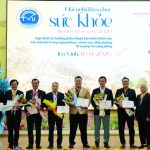
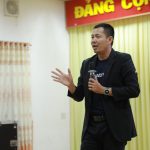
On the morning of September 27, the Ministry of Education and Training partnered with Tra Vinh University to organize a Policy Dialogue Forum aimed at building support policies for students from poor and near-poor households to enhance their learning capacity, training, and job-seeking opportunities after graduation.
The forum provides an opportunity for students from poor and near-poor households to directly share their difficulties, concerns, and aspirations during their learning, training, and job-seeking processes.
Dr. Tran Van Dat, Deputy Director of the Department of Students, Ministry of Education and Training; Dr. Nguyen Thi Thu Thuy, Deputy Director of the Department of Higher Education; and Mr. Bui Tien Dung, Senior Specialist of the Department of Students, attended the forum from the Ministry’s working delegation.
Mrs. Tran Thanh Thi, Director of the Innovation Center at Vinh Long University of Technology Education, joined as a guest.
From Tra Vinh University, Dr. Thach Thi Dan, Vice Rector of the University, participated alongside representatives from the university’s units and more than 300 student delegates.

In her welcoming speech, Dr. Thach Thi Dan, Vice Rector of Tra Vinh University, reported to the Ministry of Education and Training’s working delegation on the achievements the university has made over the past period. As of August 2025, the university has a total of 27 internationally accredited training programs, including FIBAA (Europe), AUN-QA (Southeast Asia), and ABET (United States), which helps position Tra Vinh University among the Mekong Delta universities with the most internationally accredited education quality programs.
For many consecutive years, Tra Vinh University has ranked in the Top 200 universities with green education environments and sustainable development investment, according to UI GreenMetric Ranking. The university received outstanding digital transformation awards for three consecutive years in 2022, 2023, and 2024. For the fifth consecutive year, Tra Vinh University continues to advance in the Top 100 innovative universities with real impact. Notably, the university ranks at the top of the culture and values index – B5 (WURI Culture/Value), World Universities with Real Impact (WURI), as announced by the Alliance of World Universities.
At the forum, delegates concentrated their discussions on specific topics such as direct support policies and sustainable poverty reduction target programs; Resolution 71 and directions for higher education innovation; the role of universities in implementing policies; startup and incubation linked to social impact; and policy dialogue sessions with students.

In his opening remarks, Dr. Tran Van Dat, Deputy Director of the Department of Students, noted that Resolution No. 71-NQ/TW dated August 22, 2025, of the Politburo on breakthrough development in education and training presents many important directions, including numerous contents directly related to students’ rights and opportunities.
Major policies demonstrate the great concern of the Party and the State for students, creating a foundation for the young generation to confidently study, innovate, and contribute to the country in the future.
For instance, the resolution calls for expanding financial support policies and preferential credit for learners, ensuring that no students drop out due to financial conditions. It also includes building and implementing a talent training scheme, prioritizing basic sciences, engineering, and technology; establishing a National Scholarship Fund; and promoting the effectiveness of other merit and learning encouragement funds from state budget sources and other legal sources to encourage learning and educational career development.
For the first time, a specific ratio has been established: at least 20% of the total state budget expenditure for education, with at least 5% allocated to development investment and 3% to higher education. This represents a political determination to address the prolonged resource shortage in education. The increased budget resources will create a foundation to realize reforms from curricula and staff to infrastructure.

The forum takes place as the education and training sector implements many mechanisms and policies to accompany students throughout their learning, training, and career establishment processes, contributing to disseminating, exchanging, and discussing policies while listening to the thoughts, aspirations, and suggestions of the students themselves – the direct beneficiaries of the policies. Through this, the forum evaluates what has been achieved, what difficulties remain, and proposes more suitable solutions for the coming period.
One notable task and solution is “Expanding financial support policies and preferential credit for learners, ensuring that no students drop out due to financial conditions. Building and implementing a talent training scheme, prioritizing basic sciences, engineering, and technology. Establishing a National Scholarship Fund and promoting the effectiveness of other merit and learning encouragement funds from state budget sources and other legal sources to encourage learning and educational career development.”
The State has policies to subsidize and exempt or reduce tuition fees for learners who are beneficiaries of social policies, ethnic minorities in areas with particularly difficult socio-economic conditions, orphans, children without support, people with disabilities, people from poor households, and near-poor households.
With these specific tasks and solutions, this represents a breakthrough step, demonstrating the Party and State’s deep concern for education and training, especially in expanding access to education for learners facing financial conditions.
Mr. Bui Tien Dung, Senior Specialist of the Department of Students, said that in recent years, the Party and the State have issued many guidelines and policies to care for and support students, ranging from tuition exemption and reduction policies, academic encouragement scholarships, preferential credit, to social subsidy policies and startup support. These efforts have contributed to reducing the pressure of learning costs, helping millions of students avoid dropping out due to financial difficulties, while gradually narrowing the education opportunity gap between different groups.
According to the Ministry of Education and Training’s report, many policies support learners to remove financial barriers and create conditions for students to confidently study and develop comprehensively. Currently, 100% of training institutions have established specialized units to counsel and support learners. About 25% of institutions have established student counseling, support, and startup centers. Many diverse forms of student support activities help learners practice well in various movements, such as volunteer students, organizing activities focused on seas and islands, border and island soldiers, voluntary blood donation, and the Five Good Student movement.
In particular, with the National Target Program for Sustainable Poverty Reduction for the period 2021-2025, the Ministry of Education and Training has been assigned a key task in transferring livelihood and startup models from schools to communities, helping students, especially those from poor and near-poor households, have more opportunities to rise and establish their lives and careers.
In addition, higher education institutions organize many activities to inspire entrepreneurship, creating tens of thousands of student startup projects, with many young enterprises established from students’ own ideas.
In her presentation, Mrs. Tran Thi Cuc, Head of the Student Affairs Office at Tra Vinh University, said that the university implements many policies to reduce the financial burden on students. From 2021 to 2025, the university implemented policies to exempt and reduce tuition fees, support funding for purchasing equipment and learning materials, provide social subsidies, and offer academic encouragement scholarships to students with a total value of over 60.7 billion VND. In addition, many sponsored scholarships from organizations, individuals, and businesses are available for students overcoming difficulties in their studies, amounting to about 6 billion VND annually.
The university provides 100% tuition exemption for students majoring in Traditional Musical Instrument Performance and grants a living allowance of 450,000 VND per month. It reduces 30% of tuition for the entire course for students in Cultural Studies, Musicology, and Khmer Language majors.
The university grants scholarships equivalent to 50% of tuition for the entire course for female students studying engineering and technology fields such as Traffic Construction Engineering, Construction Engineering Technology, Mechanical Engineering Technology, Electrical and Electronic Engineering Technology, Control and Automation Engineering Technology, and Automotive Engineering Technology. It grants scholarships equivalent to 30% of tuition for the entire course for female students studying Applied Chemistry.
Starting from the 2025 regular admission cohort, the university grants scholarships covering 100% of first-year tuition for students in 11 engineering and science majors and provides academic encouragement scholarships of about 15 billion VND annually for students.
The university grants scholarships equivalent to 50% of tuition for students participating in the Business Administration and Information Technology training program (English-Integrated Program). The scholarship period starts from the time students enter this program, from the beginning of Semester II (excluding the first semester of English study) of the course. However, during implementation, some difficulties and obstacles remain that need timely resolution to help students study with peace of mind.
On behalf of the university’s leadership, Mrs. Tran Thi Cuc proposed student support policies to the Ministry of Education and Training’s working delegation, including support scholarships for children of artisans and artists in the field of culture and arts, encouraging the inheritance and development of traditional ethnic forms; providing academic encouragement scholarships for ethnic minority students from disadvantaged backgrounds who achieve excellent academic results, demonstrating the spirit of “valuing talent and rewarding virtuous talent”; priority policies for female ethnic minority students from disadvantaged backgrounds to participate in academic activities, scientific research, entrepreneurship, and student leadership; policies to replace or support families of students who have just escaped poverty, creating conditions for them to continue their studies; requesting the Ministry of Education and Training to coordinate with banks to research a tuition framework by field groups to have reasonable loan amounts; and adding beneficiaries of learning cost support for monks who both practice and study, especially those from disadvantaged families who cannot work part-time to cover learning costs.
In addition, students from Tra Vinh University proposed to the working delegation several issues related to support mechanisms for students participating in innovative startup projects, attracting investment capital, and expanding the beneficiaries of tuition exemption and reduction policies.
Other photos of the dialogue forum:


Hieu Nhan