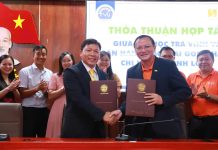
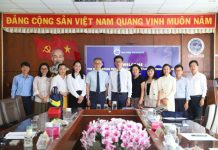
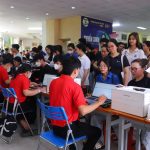
(TVU) – The School of Agriculture and Aquaculture at Tra Vinh University organized on the morning of October 24 a workshop titled “Evaluating the Effectiveness of the Co-op Training Program” to gather feedback from businesses and alumnias a basis for improving the quality of training in the coming period.
Attending the seminar were Assoc. Prof. Dr. Le Quang Minh, member of the Advisory Council of Tra Vinh University; representatives of partner companies and enterprises; and alumni of the school.
Representing Tra Vinh University were Dr. Phan Quoc Nghia, Vice Rector; Dr. Le Truc Linh, Dean of the School of Agriculture and Aquaculture; along with the leadership of departments and centers.

In his opening remarks, Vice Rector Dr. Phan Quoc Nghia expressed his gratitude to the enterprises for their support of the university’s training efforts. He emphasized that this seminar was an opportunity to comprehensively assess the Co-op program, propose improvement measures, and further promote its strengths, as the School of Agriculture and Aquaculture currently has the largest number of Co-op programs at Tra Vinh University.
Orientation for co-op program development for 2025–2030

In her report, Dr. Huynh Kim Huong, Deputy Dean of the School of Agriculture and Aquaculture, affirmed that the co-op program has brought clear benefits to all three parties — the university, businesses, and students.
For the 2025–2030 period, the Faculty will focus on: maintaining and improving the program based on feedback from businesses, coordinators, and students; enhancing students’ communication skills; encouraging students to engage in scientific research during their internships; and expanding cooperation with domestic and international enterprises to help students gain experience in a global environment.
Businesses and alumni contribute to program development

Speaking at the seminar, Assoc. Prof. Dr. Le Quang Minh emphasized the trend of competency-based education, which integrates knowledge, skills, and attitudes to help students best meet job requirements. He highlighted that enterprise survey forms are an essential tool for universities and enterprises to jointly improve training programs.
During the seminar, participants also completed quick surveys and shared direct feedback. The discussion session was vibrant, featuring many constructive contributions from businesses and alumni focusing on adjusting the duration of co-op internships and enhancing student support mechanisms, ensuring the program remains aligned with real-world needs and learners’ expectations.
Continuing partnership with enterprises and learners

In her closing remarks, Dr. Le Truc Linh, Dean of the School of Agriculture and Aquaculture, expressed sincere appreciation for the contributions from enterprises and alumni. She affirmed that the recommendations will be considered and consolidated carefully as references for reviewing and improving the co-op program — with the ultimate goal of enhancing training quality and strengthening the connection between the university and enterprises.


The seminar concluded in a spirit of openness and cooperation, marking an important step toward enhancing the effectiveness of the co-op program and fostering closer collaboration among the university, enterprises, and students.
LAN ANH