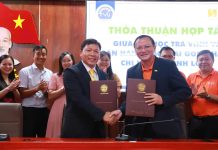
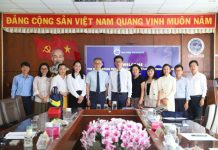
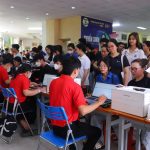
TVU – On October 27, 2025, Tra Vinh University partnered with international collaborators to organize a workshop launching the REMAOP Project (Removal of Emerging Micropollutants in the Mekong Delta by Advanced Oxidation Processes).

The workshop welcomed an expert delegation from the Kingdom of Belgium, including PhD researchers Célia Joaquim-Justo, Gauthier Eppe, Sophie Pirard, Lisa Conti, Jiri Bossunt, Carole Rougeot, Benoît Heinrichs, and Ignace Adant.
From Ho Chi Minh City University of Industry, Associate Professor Dr. Le Hung Anh, Dr. Khanh Hoang, and PhD researcher Xuan Ngoc Anh attended the workshop.
From Tra Vinh University, Associate Professor Dr. Diep Thanh Tung, Vice Rector; Dr. Huynh Ba Gia and Dr. Tran Thi Ngoc Bich, Vice Deans of the College of Engineering and Technology; Dr. Huynh Tan Thanh, lecturer at the College of Engineering and Technology; Dr. Le Truc Linh, Head of the Department of Agriculture and Aquaculture; MSc. Nguyen Thi Cam Anh, Deputy Chief of Office representing the College of Economics and Law; MSc. Pham Vu Bang, Deputy Head of the International Cooperation Department; and more than 20 students from the Department of Agriculture and Aquaculture participated in the event.

Speaking at the workshop, Associate Professor Dr. Diep Thanh Tung, Vice Rector, noted that water pollution represents one of the major challenges in the Mekong Delta. Through the REMAOP Project, TVU and international partners aim to develop and apply advanced water treatment technologies, contributing to improving environmental quality and enhancing the lives of people in the region.


The workshop focused on four main topics. Professor Benoît Heinrichs presented a project overview covering objectives, plans, partners, and expected outcomes. PhD researcher Gauthier Eppe provided an overview of chemical analysis methods supporting the project. PhD researchers Xuan Ngoc Anh and Lisa Conti reported initial experimental results on removing antibiotic residues and viruses from water sources. PhD researchers Célia Joaquim-Justo and Jiri Bossunt introduced a related project on applying biological supplements in shrimp farming.

The discussion session unfolded vigorously, focusing on the applicability of advanced oxidation technology in treating agricultural wastewater and aquaculture in the Mekong Delta. The REMAOP Project aims to remove micropollutants from water sources while promoting environmental protection linked with sustainable economic development, improving water quality, reducing production costs, and supporting local agriculture and aquaculture models.
On this occasion, the delegation toured two experimental sites of the Center for Research and Aquaculture. The first site, the Tiger Shrimp Broodstock Domestication Farm in Nha Mat Hamlet, Truong Long Hoa Ward, Vinh Long Province, covers 4.7 hectares with 2.4 hectares of construction area, including a tiger shrimp seed production farm (120 cubic meters), a large tiger shrimp nursery farm (270 cubic meters), and a practice and research area for students (30 cubic meters of water). The second site, the Saltwater Aquaculture Experimental Farm, spans 5 hectares divided into two zones. Zone 1 (2 hectares) currently develops a high-tech white-leg shrimp farming system with 2 ponds (1,000 square meters each), 1 nursery pond of 100 square meters, 1 nursery pond of 500 square meters, 3 settling ponds (7,000 square meters), and 1 waste pond (1,000 square meters).

At the working session, international experts and Tra Vinh University staff exchanged experiences and techniques for tiger shrimp farming according to practical models, while discussing cooperation directions in research, developing sustainable aquaculture technology, and adapting to climate change.
The Center for Research and Aquaculture was established on April 5, 2022, under the Department of Agriculture and Aquaculture at Tra Vinh University. The Center functions to conduct research, provide training, and transfer technology in the aquaculture field while supplying seeds, providing technical consulting to farmers, and supporting students in learning, practice, and research activities.
HIEU NHAN