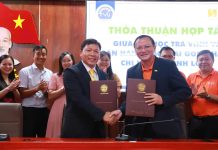
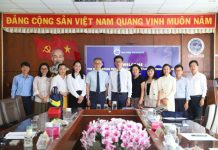
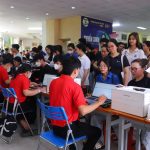
TVU – On October 24, 2025, Tra Vinh University partners with the Vietnam Association of Engineering Geology and Environment to organize the National Scientific Conference “Engineering Geology – Geotechnics and Environment for Sustainable Development” (VIETGEO 2025) in Vinh Long Province.
The event brings together nearly 100 scientists, lecturers, experts, and doctoral students from research institutes, universities, management agencies, and enterprises across the country. VIETGEO 2025 serves as an important scientific forum where participants share research results, exchange academic ideas, and promote cooperation in engineering geology, geotechnics, and environmental protection for sustainable development.
Attending the conference are Assoc. Prof. Dr. Nguyen Minh Hoa, Party Secretary and Rector of Tra Vinh University; Dr. Pham Quoc Phong, Vice Dean of the College of Engineering and Technology at Tra Vinh University; Assoc. Prof. Dr. Ta Duc Thinh, President of the Vietnam Association of Engineering Geology and Environment; Dr. Vu Thanh Binh, Deputy Director of the Department of Science, Technology and Information (Ministry of Education and Training); Prof. Dr. Tran Thanh Hai, Chairman of the Interdisciplinary Council of Professors for Earth Science – Mining and Rector of Hanoi University of Mining and Geology, along with representatives from co-organizing agencies and units.

In his opening speech, Assoc. Prof. Dr. Nguyen Minh Hoa, Party Secretary and Rector of Tra Vinh University, emphasizes that the Mekong Delta plays a particularly important role in the country’s socio-economic development. However, the region faces many challenges related to climate change, subsidence, saltwater intrusion, and resource degradation. Organizing the VIETGEO 2025 conference in this region carries practical significance and demonstrates the strong connection between scientific research and the actual development needs of both the region and the nation.
The conference proceedings, published by Transport Publishing House, feature 75 selected scientific papers, including 4 reports presented in plenary sessions and 20 reports in specialized sessions. These papers focus on current issues such as engineering geology, geotechnics, hydrogeology, construction materials, drilling and mining technology, geological hazards, and sustainable development in the Mekong Delta.


Notable reports in the plenary session include “Research on saltwater intrusion in coastal aquifers in Vietnam: Current situation and challenges” presented by Prof. Dr. Pham Quy Nhan (Vietnam Hydrogeological Association); “Developing adaptive risk assessment models for large-scale infrastructure projects in the Mekong Delta” presented by Dr. Vo Minh Huy (Tra Vinh University); and “Road embankment materials in the Mekong Delta – Challenges and solutions” presented by Assoc. Prof. Dr. Nguyen Duc Manh (University of Transport and Communications) and Dr. Nguyen Quang Dung (My Thuan Project Management Board).
The specialized sessions continue to feature many research papers with high practical value, such as applications of geopolymer materials in geotechnics, debris flow simulation, concrete deformation monitoring using IoT technology, and solutions for developing transportation infrastructure suitable for the geological conditions of the delta region.
Representatives from management agencies and scientific organizations speaking at the conference highly appreciate the role of VIETGEO 2025 in promoting connections between research and application. The conference contributes to forming an academic cooperation network among universities, research institutes, and enterprises.
In the afternoon of the same day, the conference continues with in-depth discussions in two sub-committees, featuring many research papers with high practical value and applicability.


Sub-committee 1 on Construction Geotechnics and Drilling-Mining Technology focuses on applying modern technology, new materials, and numerical simulation in geotechnical research and drilling-mining operations. These studies aim to enhance safety, efficiency, and sustainability in infrastructure construction. The reports cover topics such as debris flow simulation at Tra Leng, Da Nang City using Morpho 2DH software (University of Water Resources, University of Transport and Communications); assessment of geological map scale impacts on route selection for the Tuyen Quang – Ha Giang expressway (University of Transport Technology, University of Transport and Communications); research on shear strength of gravelly clay on samples of different sizes using plane shear equipment (Hanoi University of Civil Engineering, University of Transport and Communications); applications of geopolymer materials in geotechnics with a research literature review (Ho Chi Minh City University of Technology – Vietnam National University); comprehensive research on IoT technology applications in concrete deformation control and monitoring (Hanoi University of Mining and Geology); shallow landslide impacts on road foundation stability in mountainous areas with a case study of TL128 route in Lai Chau Province (Hanoi University of Civil Engineering, University of Transport and Communications); landslide detection based on deep learning techniques (Central University of Civil Engineering, Yamaguchi University – Japan, University of Water Resources); equivalent circulation density prediction using drilling data; and optimal design of polycrystalline diamond compact (PDC) bits for drilling through lower Miocene formations at Field X, Nam Con Son Basin (Vietnam Petroleum Institute).
Research at Sub-committee 1 shows the trend of combining data science, digital technology, and advanced materials, opening up high practical application prospects in surveying, designing, and constructing infrastructure projects.


Sub-committee 2 on Sustainable Development of the Mekong Delta focuses on technical solutions and technologies suitable for the specific geological-hydrological conditions of the delta region. The presentations aim to develop transportation, urban, and industrial infrastructure aligned with climate change adaptation goals. Papers cover topics including proposals for appropriate reinforced concrete pile lengths for small cross-sections matching the load class of low-rise buildings in the geological conditions of Trung Thanh commune, Vinh Long Province (Western Construction University, Trung Thanh Commune People’s Committee – Vinh Long); correlation between E50 modulus and unconfined compression strength (qu) of surface soil in the Mekong Delta improved with inorganic binders combined with DHD additives (University of Transport Technology, University of Transport and Communications, Dong Khang Investment and Construction Consulting Joint Stock Company – An Giang); deformation of road foundations reinforced with soil-cement piles under standard live loads in Mekong Delta geological conditions (Can Tho University); and application of saline-contaminated sand and fly ash mixtures for concrete pavement (Tra Vinh University).
Reports at Sub-committee 2 clearly demonstrate the orientation toward applying research results to the practical development of infrastructure in the Mekong Delta region. These studies contribute to minimizing the impacts of climate change, utilizing local materials, and enhancing the adaptive capacity of the regional community.


In his closing remarks, the Organizing Committee highly appreciates the serious working spirit, responsibility, and academic quality of participating scientists. VIETGEO 2025 serves as a venue for announcing new research results and functions as a connecting forum where the academic community, management agencies, and enterprises share knowledge and responsibility in sustainable development for the Mekong Delta region and the entire country.
HIEU NHAN