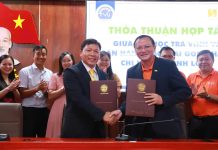
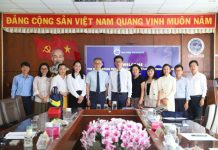
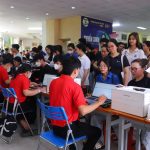
The hybrid Final Round of the International Business Case Competition 2025, jointly organized by Tra Vinh University (TVU – Vietnam), Universitas Multimedia Nusantara (UMN – Indonesia), and Southern Leyte State University (SLSU – Philippines), was held on January 9, 2026.


The competition aimed to create an international academic platform for students to demonstrate strategic thinking, analytical skills, and problem-solving abilities through real-world business cases. At the same time, it provided students from the three countries with opportunities to interact, exchange ideas, and broaden their global perspectives in the field of sustainable business.
Within the final round, participating teams first addressed a business case provided by SLSU – Philippines, entitled “EcoFresh: Balancing Sustainability and Profitability in a Small Business,” which was developed based on the real context of a local enterprise. Following this round, the Panel of Judges selected 10 outstanding teams to advance to the final stage, where they continued the competition with a Vietnam-based case titled “Tien Trang Farm: Balancing Educational Agritourism Development and Sustainability in a Local Agricultural Model.”


This case required teams from different countries to propose development strategies for an educational agritourism model at a local farm while ensuring environmental, social, and financial sustainability—an applied challenge closely aligned with real-world practices and the Sustainable Development Goals (SDGs).
In the Final Round, Tra Vinh University was represented by three teams: Cuhati, consisting of Ly Gia Han, Le Thi Tuyet Trinh, and Duong Ngoc Thu Thao; Healthmate, with Tran Minh Phuong, Nguyen Thanh Nguyen, and Doan Vuong Bao Han; and FinBridge, represented by Son Tran Minh Man and Nguyen Thi Ngoc Hanh. Each team was given 7 minutes to present their proposed solutions, followed by 5 minutes of Q&A with the Panel of Judges.
Teams were evaluated based on five main criteria: (1) the ability to analyze and accurately understand the problem; (2) the feasibility and effectiveness of the proposed strategic solutions; (3) the level of social and environmental impact; (4) creativity and innovation in approach; and (5) presentation and communication skills in English throughout the competition. As a result, the Cuhati team—Ly Gia Han, Le Thi Tuyet Trinh, and Duong Ngoc Thu Thao—won Third Prize overall, earning high praise for their strategy that harmoniously balanced business expansion with the preservation of local values, as well as for their sharp and well-structured responses during the Q&A session.
“The competition allowed us to approach and solve real-world business cases while developing teamwork skills, critical thinking, and English presentation skills in an international academic environment,” shared Ly Gia Han, a member of the Cuhati team. “Through each round, we analyzed and proposed solutions for business cases from enterprises in the Philippines and Vietnam. The competition helped us apply our knowledge flexibly and gain a deeper understanding of the role of sustainability in business.”
Representing both the Panel of Judges and the Organizing Committee, Mr. Nguyen Van Vu An, Director of the Center for Innovation and Entrepreneurship and Director of the Tra Vinh Business Incubator, shared, “The competition was not only an opportunity for students to demonstrate their ability to analyze and solve real business problems but also an international academic experience that helped them develop strategic thinking, critical reasoning, and professional presentation skills. Given the same case, each team approached the problem from different perspectives and proposed feasible, creative solutions suited to the business context. Many solutions showed an effective integration of academic knowledge and practical understanding, reflecting the seriousness and quality of training of the participating universities.”
Tien Trang Farm: Balancing educational agritourism development and sustainability in a local agricultural model
Tien Trang Farm is an ecological agricultural model situated in Truong Long Tay Commune, Can Tho, developed in accordance with the philosophy of living in harmony with nature and promoting a zero-waste circular economy. The farm focuses on organic durian cultivation that meets OCOP standards, combined with goat farming to produce organic fertilizer. Additionally, it features ground-cover vegetation under tree canopies to prevent soil erosion and a circular canal system for freshwater fish farming, utilizing by-products to help purify water sources.
In addition to agricultural production, Tien Trang Farm preserves a wetland ecosystem that is home to many rare waterbird species. The farm also welcomes visitors for tours, experiential learning, and educational activities related to green agriculture, circular economy practices, and nature conservation, gradually positioning itself as a distinctive agritourism and eco-tourism destination in the Mekong Delta region.
The challenge for participating teams was to propose a strategy for developing an educational agritourism model aligned with green tourism and circular agriculture principles, suitable for limited resources, while ensuring a balance between ecological conservation, economic efficiency, and long-term educational value.